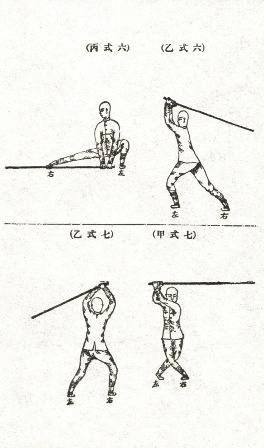
Security forces training While the books used in our survey already discussed in part I were aimed to civilians a few had either the police or the army as target audience. One of the first comprehensive curriculums created in the early XXth Century was Ma Liang’s Zhonghua Xing Wushu (New Martial Arts of China) published […]
Category: Translations
Defining Chinese Martial Arts in the Republican Era
During the Republican period (1912 to 1949) the proponents of the National Essence Movement sought not only to promote native martial practices but also its technical and theoretical study by applying modern western methodologies. Chinese martial arts have been described in different ways over the centuries, however it would not be until the beginning of […]
Qi Jiguang’s Influence on Asian Martial Arts
General Qi Jiguang (1528 – 1588) was born in a hereditary military family in 1528 at Dengzhou, Shandong province. Qi received education in both the Classics and military skills from a tender age and assumed his father’s rank in 1544. He took the military examinations receiving the Juren degree in 1549, but was unsuccessful in […]
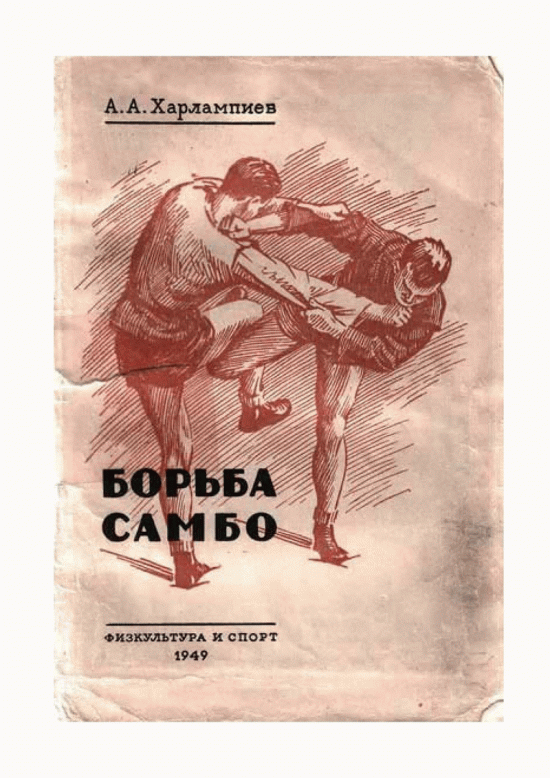
Japanese Martial Arts in Russia, The creation of Sambo and Sino-Russian Cooperation at Whampoa
Note: Updated on 8/12/2017 When Japan was forced to open its borders to foreigners beginning the Meiji Restoration, it also helped spread Japanese culture overseas in the form of movements like Japonism (from the French Japonisme) or the interest for Japanese objects from around 1872 onwards. This movement influenced European arts and culture, even though […]
An Overview of Chinese Martial Arts in the Olympics
“It is difficult to find a Chinese citizen in good shape, eager to learn new things, with a strong and proper attitude in life, this makes them lack courage and motivation. They have the characteristics of sick men; How many generations must pass until we realize that this situation must change? We must wake up […]
Ma Liang – Chinese Martial Arts Modernizer, Warlord and Traitor
The China of the early XXth century experienced major political and social changes thanks to a combination of local and foreign forces creating the right environment from which many reformers arose. In the realm of Chinese martial arts, Ma Liang (馬良) also know as Ma Zizhen (馬子真, 1875-1947) would give a start to the modernization […]
Perceptions of the “Sick” Men of East Asia in Spanish-speaking Countries
A Chinese martial arts master has died, the students make preparations for his funeral in anticipation of those people seeking to pay their respects. During a moment of silence following a speech by one senior member of the Chinese school, a group of Japanese martial artists make their entrance and arrogantly offered their “respects” to […]
Martial Studies in Latin-America
“El hijo del Li Yuan, Li Shimin 李世民(el segundo emperador de la Dinastía Tang) quedó aprisionado en Luoyang. Para salvar a su hijo Li Shimin, Li Yuan buscó la ayuda del Monasterio Shaolin para reprimir la revuelta dirigida por Wang Shichong 王世充y rescatar a su hijo. El abad del monasterio Shaolin Zhi Cao y doce […]
Christian Warlord and Martial Artist, Feng Yuxiang
One of the topics I find fascinating is the practice of Chinese martial arts in the early XX Century. Specifically the Big Knife Units for which we are in the process of preparing a paper to be released in the near future. The main sponsor of such fighting units was Feng Yuxiang nicknamed the Christian […]
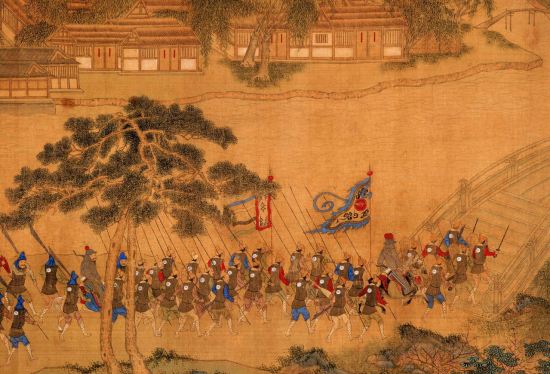
Ming Victory over Japanese Pirates Scroll
Credits to Azusa M. for her help with the Japanese text. After a hiatus to take care of my new baby girl and a holiday to the Rockies I got the itch to write again. A post in the Kung Fu Tea: Martial Arts History, Wing Chun and Chinese Martial Studies Facebook page reminded me […]